Make the powder identifiable before you decant it
Start with the original supplement packaging and its instructions. Determine the amount with an appropriate measure, then decide how to identify it after transfer. Keep the powder name and any instructions you need available. If you carry more than one formulation, use a clear external label or a separate identifiable pouch rather than relying on two similar black containers to tell the contents apart.
A protein container does not preserve the information that was on the original tub. Identification becomes especially useful when one measured portion is prepared for a different time or purpose from another. This is an organization suggestion, not advice to combine powders or change a serving. There are no dosing marks or verified dosing accuracy for the featured accessory.
Check the portion against the chamber
The featured protein powder container is listed as 50 ml per container. First measure the intended powder; then see whether its loose volume fits while allowing the cap to close normally. Do not press powder into the threads or increase the amount because unused space remains. The container volume and the supplement amount answer different questions.
Consider two labeled containers for two separate, already measured portions. Each portion needs its own capacity check. The two-pack does not create a single larger chamber, and we do not know a universal powder weight for either one. A seller image mentions 20 grams, without identifying the powder or filling conditions. That graphic cannot predict what every powder will fit.
| Checkpoint | A useful record | Recheck when |
|---|---|---|
| Identity | Powder name and original instructions | The formulation changes |
| Amount | How the amount was measured | The label or measure changes |
| Space | Whether the cap closes without obstruction | The portion or powder changes |
| Contents | Two containers described; accessories shown | The listing option changes |
Close, inspect, then pack
Fill through the wide opening with the small base cap in place. Check that powder has not collected in the cap interface and close the top and bottom normally. Inspect the assembly before putting it in the bag. If a cap does not engage as expected, stop and resolve the obstruction rather than forcing it. The seller describes reinforced dual caps but provides no independent air-tight, moisture-barrier or liquid-leak test.
The protein funnel is shown with a ring and clip for attaching to a bag. Decide whether an accessible dry pouch is a more suitable place in your own bag, particularly around wet towels or drink bottles. A pouch is an organization choice and is not a substitute for verified sealing. The clip has no load rating and should not be used as safety equipment.
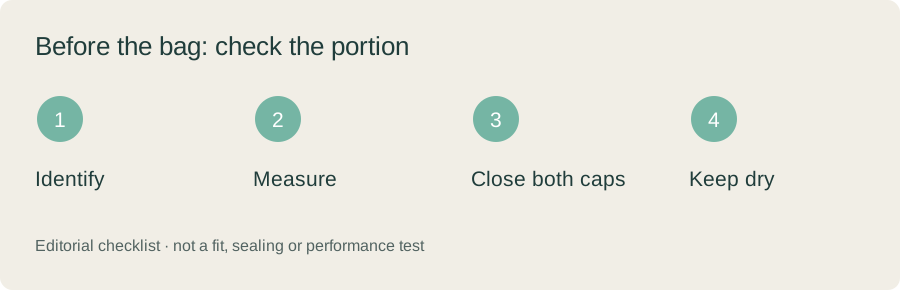
Keep a short reset after use
A protein powder dispenser with a removable base cap is manually emptied; it is not an automatic metering device. After the transfer, inspect what remains in the chamber before deciding whether the portion moved as intended. Do not assume that an empty-looking exterior means every particle was released.
Keep used pieces separate from clean, dry powder until they are cleaned and dried. The seller names hand washing and dishwasher cleaning but leaves program and accessory details unspecified. Confirm those instructions rather than inventing a cycle. Before refilling, inspect the chamber, outlet and cap interfaces for visible residue, moisture or damage. This routine does not prove allergen removal, sanitation or a particular powder shelf life.